
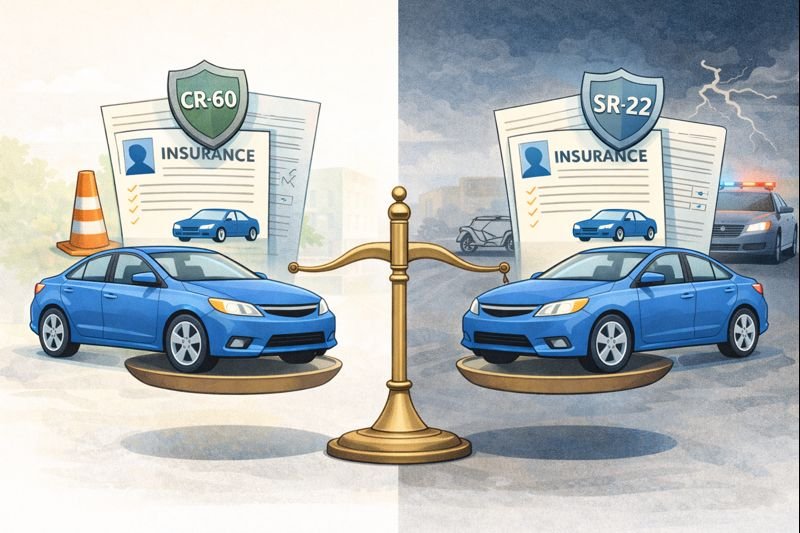

Drivers who are required to prove financial responsibility after serious traffic or insurance violations are often confused by different state filings. Two of the most commonly misunderstood are SR-22 and SR-22. While both serve a similar regulatory purpose, they are not interchangeable and apply to different legal situations depending on state law and the nature of the violation.
This article explains SR-22 insurance vs SR-22 differences, helping drivers understand when each filing is required, how they work, and what compliance obligations come with each.
Understanding Financial Responsibility Filings
Financial responsibility filings are tools used by state Departments of Motor Vehicles (DMVs) to ensure that high-risk drivers maintain continuous liability insurance. These filings create a direct reporting relationship between the insurance company and the state.
When a driver’s policy is canceled, lapses, or changes, the insurer must notify the DMV. This oversight protects the public by preventing uninsured drivers from legally operating vehicles.
Both SR-22 and SR-22 fall into this category—but they are governed by different rules.
What Is SR-22 Insurance?
SR-22 insurance refers to a financial responsibility filing submitted by an insurance company to certify that a driver carries valid liability insurance meeting state minimum requirements.
SR-22 is most commonly required when:
-
A driver is suspended for insurance-related violations
-
An uninsured at-fault accident occurs
-
A court orders enhanced insurance monitoring
-
A state identifies a driver as a recurring insurance risk
The filing remains active for a fixed period, during which continuous coverage is mandatory.
What Is SR-22 Insurance?
SR-22 is also a financial responsibility filing, but it is more widely known and used across many states. It is commonly required for:
-
DUI or DWI convictions
-
Reckless driving
-
Multiple moving violations
-
Driving without insurance
Like SR-22, SR-22 is filed by the insurer and obligates the company to notify the DMV if coverage ends.
Despite these similarities, SR-22 and SR-22 are governed by different statutory frameworks.
Core SR-22 Insurance vs SR-22 Differences
Understanding the differences between SR-22 and SR-22 is essential for compliance. Filing the wrong form—or assuming they are interchangeable—can result in license re-suspension.
Legal Basis
-
SR-22 is often tied to specific insurance-related or financial responsibility statutes.
-
SR-22 is commonly associated with broader traffic safety and DUI laws.
Triggering Violations
-
SR-22 is frequently required after uninsured driving or insurance lapses.
-
SR-22 is more often imposed for DUI, reckless driving, or repeated traffic offenses.
State Usage
-
Some states use only SR-22
-
Others use SR-22 or equivalent filings for certain violations
-
A few states maintain multiple filing types for different legal scenarios
Filing Process Differences
Who Files
Both SR-22 and SR-22 filings are submitted exclusively by insurance companies. Drivers cannot file either form themselves.
Filing Method
-
Electronic filing is standard for both in most states
-
Paper filing may still be used in limited jurisdictions
Acceptance and Monitoring
Once accepted, the DMV monitors both filings continuously until the requirement period ends.
Coverage Requirements: SR-22 vs SR-22
While both filings require liability insurance, coverage standards may differ.
-
SR-22 often requires strict adherence to state minimum liability limits
-
SR-22 may require higher limits in certain states, particularly after DUI convictions
Drivers must meet the exact coverage requirements associated with their mandated filing type.
Duration Requirements and Compliance Periods
The required duration for maintaining SR-22 or SR-22 varies by state and violation severity.
-
SR-22 typically requires 1–3 years of continuous coverage
-
SR-22 commonly requires 2–5 years, especially after DUI offenses
Any lapse during the required period usually resets the compliance clock.
Can You Switch Between SR-22 and SR-22?
In most cases, no. Drivers cannot choose which filing to submit. The DMV or court specifies the required form based on statutory authority.
Switching filings without approval can lead to:
-
Filing rejection
-
License suspension
-
Extended compliance periods
Only a state agency can authorize a change in filing requirements.
Cost Differences Between SR-22 and SR-22
Costs depend on:
-
The driver’s risk profile
-
State insurance regulations
-
Severity of violations
In some states, SR-22 may be more expensive due to DUI-related risk. In others, SR-22 costs may be comparable or slightly lower. The filing fee itself is usually minimal, but premiums reflect overall risk.
Owner vs Non-Owner Policies for Each Filing
Both SR-22 and SR-22 can be attached to:
Owner Policies
Required for drivers who own vehicles. These policies typically cost more.
Non-Owner Policies
Designed for drivers without vehicles. Non-owner policies often provide a more affordable way to meet filing requirements.
Eligibility depends on state law and individual circumstances.
Consequences of Filing the Wrong Form
Submitting the wrong financial responsibility filing can result in serious consequences:
-
Immediate license re-suspension
-
Rejected reinstatement applications
-
Additional fines and fees
-
Restarted compliance periods
Always confirm the required filing type with the DMV or court before purchasing insurance.
How to Ensure Proper Compliance
To avoid errors when dealing with SR-22 or SR-22:
-
Review all DMV or court notices carefully
-
Work with insurers experienced in high-risk filings
-
Confirm filing submission and DMV acceptance
-
Maintain continuous coverage without lapses
Proactive compliance reduces legal and financial risks.
Frequently Asked Questions About SR-22 vs SR-22
Are SR-22 and SR-22 interchangeable?
No. They are legally distinct and cannot be substituted.
Can one state require SR-22 while another requires SR-22?
Yes. Filing requirements vary by state law.
Does one filing affect insurance rates more than the other?
Rates depend on the violation, not just the filing type.
Do these filings permanently affect my record?
The filing requirement is temporary, but the underlying violation may impact insurance history longer.
Key Takeaways: SR-22 Insurance vs SR-22 Differences
-
Both are financial responsibility filings, not insurance policies
-
SR-22 and SR-22 serve different legal purposes
-
Filing requirements depend on state law and violation type
-
Continuous coverage is mandatory for both
-
Incorrect filing leads to severe penalties
Understanding SR-22 insurance vs SR-22 differences helps drivers comply with state law, avoid unnecessary penalties, and regain legal driving status efficiently.